Nymphalidae

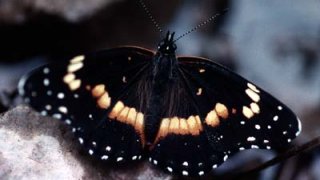
With about 6000 species worldwide, the morphological diversity within the brushfoots is immense. There have been decades of debates about how to classify the group and what traits are important and useful. For our purposes, the uniting characteristic of the brushfoots is the reduction of the front pair of legs into small, brush-like appendages that serve no real function, rather like the human appendix or tailbone. As a result, while they still have 3 pairs of legs (an insect characteristic), only two of those leg pairs are actually functional. Brushfoots are some of our largest and recognizable butterflies, including the monarch (Danaus plexippus), painted lady (Vanessa cardui), California tortoiseshell (Nymphalis californica), and mourning cloak (Nymphalis antiopa).


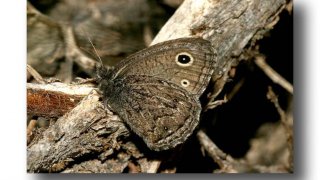
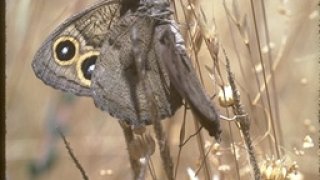
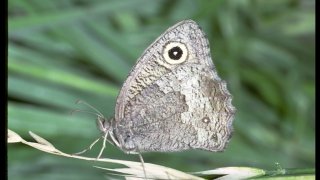
Oeneis chryxus ivallda

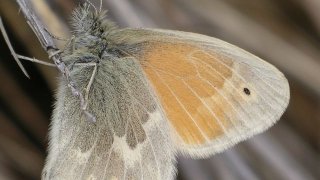
This is the signature butterfly of the alpine zone in the Sierra Nevada. Castle and Basin Peaks are near its northern limit, which appears to be Mount Lola, a few miles farther north. The Ivallda Arctic is extremely cryptic at rest on the ground; if startled it flies briefly, then lands again and disappears. The male has a rather pointed forewing amnd a greenish stigma in the middle of the wing. The female is larger, with more rounded wings and usually two large eyespots; it lacks the stigma.

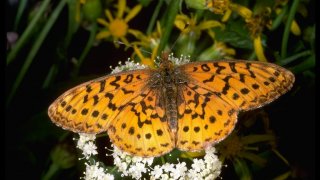
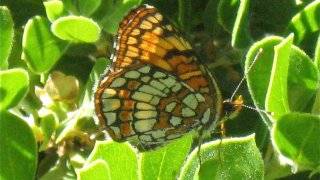
Phyciodes campestris campestris

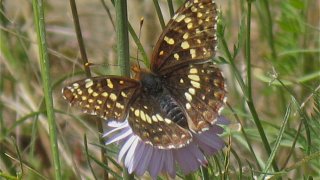
The low-altitude subspecies of P. campestris (also called P. pratensis and P. pulchellus) occurs in local colonies in the Sacramento Valley and Delta and in the Coast Range, but only barely ascends the Sierran West slope. It is "capped" by a "no man's land" where no members of the species occur, and above that the endemic montane P. c. montana. Nominate campestris and montana intergrade in the Feather River Country (formerly including Sierra Valley).

Phyciodes campestris campestris/montana

In the upper Feather River drainage occur highly variable populations phenotypically intermediate between Phyciodes campestris campestris and the endemic high-Sierran P. c. montana. The population of this complex in Sierra Valley was formerly one of these, but it went extinct for unknown reasons. Today we find-rather uncommonly-a montana-type animal in the same area. The metropolis of the intergrading populations now seems to be the vicinity of Caribou Road, near Highway 70, where every conceivable intermediate phenotype can be taken.

Phyciodes campestris inornatus

This is a relatively pale entity with broader median yellow band characteristic of the western Great Basin and Northeastern California populations found with Aster along watercourses in sage brush steppe. It appeared and apparently bred in Sierra Valley in 2008 in a different location from P. c. montana. It is the only P. campestris found between Beckwourth Pass and Hallelujah Junction, a few miles northeast of our Sierra Valley site.

Phyciodes campestris montana

Abundant in the Sierra Nevada from about 4000' to tree-line; occasionally lower in canyons with cold-air drainage (as at Washington). There is a "no-man's land" in the foothills occupied by neither P. campestris campestris nor P. c. montana. In northwestern and northeastern California, north of the range of P. c. montana, P. c. campestris goes right up to tree-line! The northern end of the range of the Sierran-endemic entity montana is occupied by a swarm of intermediate and highly variable populations throughout the Feather River drainage.

Phyciodes mylitta

An abundant, weedy species found at all sites on the transect, though it may not be a permanent resident. The Mylitta Crescent breeds on Thistles. It originally used native species of Cirsium, probably mostly in wet habitats. With the naturalization of weedy European species of Cirsium, Carduus and Silybum, it is now found in all kinds of disturbed (including urban) habitats.

Phyciodes orseis herlani

The Sierra Nevada subspecies, herlani, of the California Crescent is uncommon and spottily distributed, but its lack of highly visible distinguishing characteristics may result in it being seriously underreported. It almost always co-occurs with the much commoner Mylitta (P. mylitta) and Montana (P.

Polygonia faunus

Usually uncommon. A species of cool, mesic forest, best recognized by its very irregular wing margins and by the green lichen-simulating markings on the underside of all wings in the male. The female is rather uniform, dull gray below. As usual in Polygonia, hibernates as an adult. It is not clear whether it has one generation a year or perhaps (in some localities) two. Rarely seen at flowers; yellow Composites and Aster are most frequently cited.

Polygonia satyrus

Strongly seasonally dimorphic, this is our only Polygonia found on the floor of the Central Valley as well as in the hills to mid-elevation. The wood-brown underside is diagnostic. Virtually limited to riparian habitat and tule marsh, near its host (Urtica holosericea, the common tall, native stinging nettle), but usually scarce to rare, and in retreat from civilization. Adults hibernate; a new brood in late spring-early summer and another in August-September (hibernators). Males territorial in sunflecks at or near ground level.

Polygonia zephyrus

The commonest and most widespread Polygonia, occurring at Gates Canyon and all the Sierran sites. As usual, it hibernates as an adult, appearing quite soon after snowmelt in the mountains and as early as late winter at Gates. We suspect this name includes two biological species in the Sierra Nevada, one of which arrives by upslope migration in late spring in the high country while hibernators are still common; there are subtle phenotypic differences. Who will do the molecules?