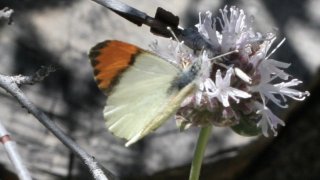
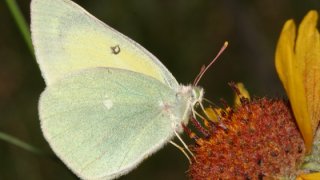
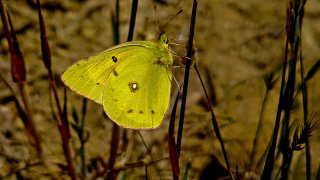
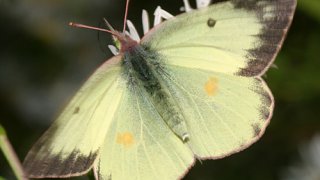
Pieridae

Pierids are rather conspicuous white, yellow, or orange butterflies, with around 1000 species worldwide. They primarily feed on plants in the legume and crucifer families, although some odd groups, like our Neophasia menapia, feed on conifers. Some Pierids, especially Colias sulphurs and Pieris whites, have taught us much about species recognition (based on ultraviolet reflectance patterns) and seasonally-induced polymorphism and phenotypic plasticity.


Nathalis iole

This common species of the Southwest deserts and Mexico strays irregularly northward, occasionally in numbers (as in 1992), but is not known to breed here. It has been recorded near sea level (Sacramento Valley and Bay Area) and in the mountains (even on Castle Peak!). It is a very peculiar species--there is only one other species in the genus and it is from the Andes, and our species occurs disjunctly in the alpine zone of the isolated Sierra Nevada de Santa Marta in northeastern Colombia, South America. In North America, cold-season broods may be very dark on the hindwing beneath.

Neophasia menapia

The Pine White is only very distantly related to our other Whites; its roots lie in both the Old and New World Tropics, and it is apparently descended from mistletoe-feeding ancestors. Perhaps it "got onto" pines by way of the pine mistletoes, genus Arceuthobium? At any rate, it occurs in pine forests from the upper foothills to the subalpine and on both slopes of the Sierra, and in the Coast Range north of the Bay. Adults "lek" (a type of mate-locating behavior) by spiraling around the upper parts of pine trees.

Phoebis sennae

A rare stray from the subtropics, which can turn up literally anywhere - from downtown Fairfield to the high desert in Lassen County. There was a major cluster of northern California records in 1992. Generally flies high and fast, and can be difficult to tell from female California Dogface or Black and Gold Sulphur. Not known to breed in northern California, and no native host plants are present. Females are very variable in color and pattern.

Pieris napi

A characteristic species of moist mesic forest in late winter and early spring, apparently not breeding above 5000'. It flies in dappled light and shade, often high off the ground, with rather infrequent wingbeats compared to P. rapae. In the gloom its brilliant white color often makes it look bigger than it is. This species has a very dramatic seasonal polyphenism: first-brood specimens have more or less bold, black vein-lines on the hindwing beneath, while second-brood ones (where they occur) are usually immaculate white (or pale yellowish).

Pieris rapae

Our only introduced butterfly - from the Old World - this is also one of our weediest, occurring in disturbed habitats from sea level to about 8000'. It even invades riparian woodland and montane coniferous forest habitats in summer. We are not certain how or when it reached our area. We know the species was introduced in southern Canada in the 1850s; the great Lepidopterist Samuel H. Scudder traced its spread, but was unable to resolve the history on the West Coast. It was not in San Francisco in the early 1880s, but was abundant by the time of the earthquake (1906).

Pontia beckerii

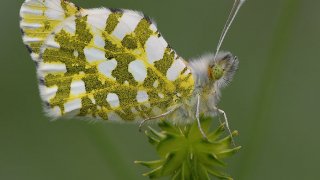
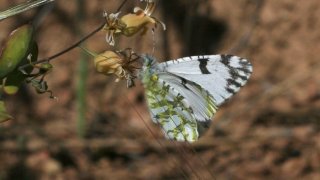
A characteristic species of the East slope and Great Basin, sporadically breeding at Donner Pass but not persistent and not descending the West slope. Its green underside mottling is distinctive and unique in our fauna. The early-spring brood is small and very intensely-colored, with the underside mottling dark blackish-green. It flies slightly later than the Western White in most places.

Pontia occidentalis

Very similar to the Checkered White, which it largely replaces at higher elevations. Our Western White is probably conspecific with the Old World Pontia callidice, and alpine or early-season specimens of ours are indistinguishable from the Himalayan taxon P. c. kalora.

Pontia protodice

In the 1970s this species was often abundant at low elevation along the transect, overwintering only locally and sporadically-mostly on dredge tailings along the American River. It has since become much rarer and in most years is seen only in September and October. At Sierra Valley it overwinters unpredictably but colonizes each year from the desert in May or June, and usually becomes common by late summer. It has been recorded at all sites but is not a permanent resident at any of them at this time!

Pontia sisymbrii

Always single-brooded early in the season, this is a species of rocky, unforested sites including serpentine barrens and the alpine zone. It also occurs on lava flows in Sierra Valley, straying to adjacent roadsides and alfalfa fields. The interrupted vein-lines on the underside of the hindwing are diagnostic, as is the dumbbell-shaped black spot at the end of the forewing cell. Many females are distinctly pale yellow. Higher-altitude specimens average slightly smaller, with crisper and blacker markings than foothill ones. A very infrequent stray to the Sacramento Valley.