Hesperiidae

The skippers are a worldwide family of about 3500 species that appear to be "sister" to the rest of the "true butterflies". The clubs on the tips of the antennae are usually hooked. Our California skippers fall into two or three subfamilies: the spread-wing skippers (Pyrginae), the folded-wing skippers (Hesperiinae), and the Heteropterinae.

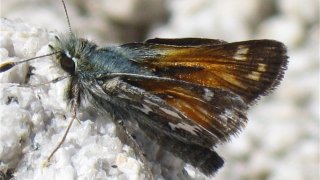
The spread-winged skippers are generally dark brown and hold both sets of their wings open when landed. They use a wide variety of hostplants, including oaks, Ceanothus, legumes, mallows, and even saltbush. California genera include PyrgusHeliopetesErynnisThorybesEpargyreus, and Pholisora.

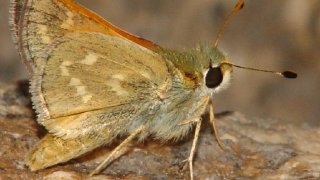
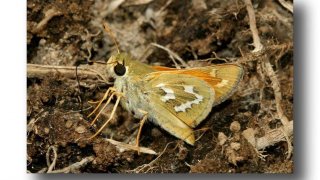
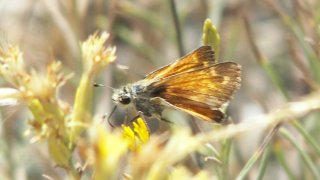
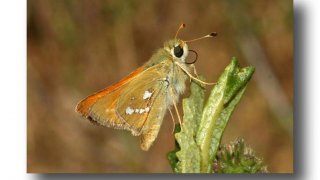
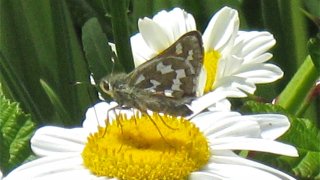
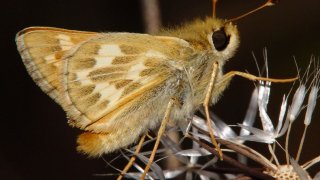
The folded-wing skippers have a characteristic posture when they land: the forewings are held at a 45o angle to the rest of the body while the hindwing is held open and flat. This gives them a "fighter-jet" like appearance. They are largely orange and tawny, and many have whitish chevrons on the ventral hindwing, although some genera are dark brown. All members of this group feed on grasses or grassy-like plants (like sedges and rushes) as caterpillars, and as a result, they are often called the grass skippers. California genera include HesperiaOchlodesPolitesPoanesHylephilaLerodeaAmblyscirtes, and Atalopedes.

A third subfamily, the Heteropterinae, is weakly differentiated from the other skipper subfamilies, but the lone California representative is distinctive: Carterocephalus palaemon.
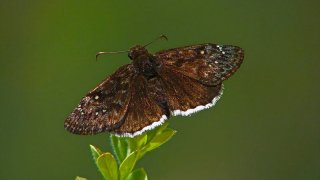
Erynnis tristis

Common below 2000', including the Sacramento Valley; the only Erynnis routinely found in cities. A strong flier but not a very dedicated puddler, it is multiple-brooded, from March to October. This is the only common Dusky-Wing with a white fringe (compare E. funeralis).

Heliopetes ericetorum

This species is uncommon in our area but can turn up literally anywhere, from sea level to near tree-line-generally as singletons. It appears to migrate through our area twice a year, northward in May-June and southward in September-October, but we do not know where it is coming from or where it is going. Breeding populations are scarce, generally in chaparral, where the host - Bush Mallow, genus Malacothamnus, occurs. Adults visit a great variety of flowers and turn up as often in urban and suburban gardens as anywhere else.

Hesperia colorado harpalus

The taxonomy of this entity has undergone some very unfortunate turbulence recently. It used to be put in the species Hesperia comma, and its subspecifixc name used to be yosemite. The name harpalus was used for the East slope subspecies, which is very different. (Got that?) As now construed, harpalus refers to the single-brooded entity with a very lightly-marked, mostly golden ventral hindwing in the male and a highly variable spot-pattern on the same wing in the female, incorporating a c-shaped element on the basal half.

Hesperia colorado idaho

Until recently, this was known as Hesperia comma harpalus. Now the name harpalus has been switched to the very different West slope entity (formerly called yosemite) and most North American populations have been removed from species comma to colorado. At any rate, this insect is common along the Sierran East slope, including Sierra Valley, and on into Nevada. It looks very unlike the West slope animal.

Hesperia colorado ssp.

Populations of Hesperia colorado (as determined by the genitalia) occur at scattered locations on the Sierran west slope on serpentine substrates and fly in autumn - mid-September into October. One of these occurs on serpentine along Washington Road, where it is sandwiched between "normal" populations of what is now called H. colorado harpalus but used to be called H.comma yosemite, which fly in June-July both higher and lower but on metasedimentary substrates!

Hesperia columbia

The Columbian Skipper is found mainly in the Coast Range. In the Sierra Nevada it is known from only a handful of localities, mainly on serpentine. None is on the transect. Its only population on the transect is in the chaparral at the head of Gates Canyon; individuals are encountered only sporadically on the sampling route, but if the route included any rocky summits it would be a "regular" since it is a confirmed hilltopper. It also occurs in Lagoon Valley Regional Park, where it hilltops along the crest of the Cement Hill range. There are two broods, in May-July and September-October.

Hesperia juba

A striking, large skipper, like a very big East-slope Colorado Skipper with a strongly greenish tinge to the body pelage and hindwing beneath; a very strong flier; males perch on or near the ground. Although strays are occasionally taken at low altitudes, this is quintessentially a montane species, from 2000' to tree-line. It flies shortly after snowmelt (early June at Donner, e.g., visiting early Dandelions and Pussy Paws) and again, much more commonly, in autumn (August-October, mostly at Aster and Rabbitbrush).

Hesperia lindseyi

Our populations have been named as a weakly-distinguished subspecies, H. lindseyi eldorado. An uncommon butterfly largely restricted to serpentine grassland, usually in places where there is a big display of Clarkia blossoms in late spring. This species is often sympatric with H. colorado, which it strongly resembles, but both colorado entities (q.v.) in our areea fly later in the year--one of them, much later.

Hesperia nevada

In our area a high-altitude species, generally found in cold, windwept sites where males hilltop. Both sexes visit puddles and can often be seen on the wet soil adjacent to melting snowbanks. At Donner confined to the east end of the pass; on Castle and Basin Peaks and on rocky knobs along the ridge in between. This species appears to have decreased in abundance in recent years and is no longer seen every year on the transect. It usually flies in July but there are a few records as late as September. The hosts are presumed to be perennial bunchgrasses.

Hylephila phyleus

California's most urban butterfly, almost limited to places where people mow lawns. Its range extends to Argentina and Chile and it belongs to a large genus which is otherwise entirely Andean. Its North American range may be quite recent. Here in California, the oldest Bay Area record is only from 1937. At any rate, it is multiple-brooded, and appears to experience heavy winter-kill in most places; scarce early in the season, it spreads out from local places where it survived, gradually reoccupying most of its range by midsummer and achieving maximum abundance in September and October.